Breed History - In Brief
At mid 1600´s when the South African cape was first settled by whites, they found the local tribes (the Hottentots) to have their own half-domesticated camp dog. The Hottentot dog were considerably smaller and less attractive in looks than the Ridgebacks of today, they had longer hair, small prick ears, curled tail and on its back a ridge of hair growing to opposite direction of normal. It is thought that the Hottentot dogs interbred with dogs from the Bakalahari tribe which were cleaner cut dogs similar to Grayhound. These early dogs were used for baying big game e.g. lion, baboon and leopards. Apart from being excellent hunters they also were known for their loyalty to their owners.
The early settlers were very keen on hunting and imported some European dogs to be used in breeding with the Hottentot dogs. The aim with these imports was to complete the Hottentot dogs capabilities as a hunter and also improve its appearance. In the early breedings Today we credit three men for being mainly responsible for the early work within the breed. These men are Charles Helm, Cornelius van Rooyen and Francis Barnes. The most important step towards the breed was taken in 1870 when the Reverend Helm brought two ridged bicthes - Powder & Lorna - from Swelledam to Hope Fountain Mission in Rhodesian (Zimbabwe). There big game hunter Cornelis Johannes van Rooyen first met with ridged dogs and fell for their looks and ability to guard.
Van Rooyen interbred Helm´s two bitches with his own hunting dogs. According to research material on Cornelis van Rooyen, his hunting pack consisted Pointers, Irish Terriers, Collies, Bulldogs/Grayhound mixes, Deerhound (Grayhound) and Great Danes. The ridged puppies from the matings joined van Rooyen´s pack and thus spread the ridge factor. By 35 years of selective breeding van Rooyen established a dog that was known for its hunting prowness (especially for baying lions and other big game) and for its ridge. These dogs were first known as van Rooyen´s Lion Dogs.
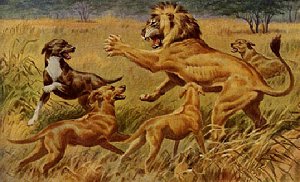
The name Lion Dog established its name within the hunters as they noticed the capabilities of the ridged dogs. The name seemed to be somewhat misleading as by result some people thought that the lion Dogs literally killed lions. Obviously that was a misunderstanding as no dog is able to win the King of the Beasts in battle. The Lion Dogs hunted in packs of 3-5 dogs, their main purpose was to chase, aggravate, tire and to hold the lion at bay so the hunter would be able to get the good aim at the lion and shoot it. During the chase the dogs parted so that one chased the prey directly from behind and the others from the sides. The Lion Dog needed to have great love of chase, courage, agility, intelligence and stamina to be able to stay alive.
Still it is Mr. Francis R Barnes that occupies the most prominent place in the Ridgeback history. He bred Ridgebacks under the Eskdale prefix and his first ridged dogs were obtained from Graham Stacey´s Dewsbury pack and originated to van Rooyen´s dogs. Francis Barnes was the founder of the Parent Club in Rhodesia and was also instrumental in the process of writting the breed standard in 1922-1924. The standard is based on the the Dalmatian Breed Standard. The breed were officially accepted in the Kennel Union of South Africa (KUSA) and the first ridged dogs were registered in September 1924.
|
Sources: The Rhodesian Ridgeback -The orging, history and standard/ T C Hawley The Definitive Rhodesian Ridgeback/ David H. Helgesen The Rhodesian Ridgeback Indaba/ Janet Murrey The Complete Rhodesian Ridgeback/ Janet Parker & Peter Nicholsson |